
Cellular Automata Watch Bands
Lorelei Koss
This work is a collection of three watchbands, each using a cellular automaton connected to its watch head's function: a firing-squad synchronization automaton for the A-11, a World War II military watch built for precise coordination; a probabilistic automaton for the E. Howard, an atomic watch designed for timekeeping accuracy; and an encryption automaton for the Apple Watch, a digital device engineered for secure communication. Each band uses a cellular automaton whose pattern mirrors a defining feature of its watch, making visible the mathematical principles embedded in each design.
Informally, a cellular automaton is a row of cells that update their states at regular intervals. At each discrete time step, every cell examines its own state and the states of its immediate neighbors, then applies a rule to determine its next state.

A11 Watch: Synchronization
The first watchband is designed for the A-11, a World War II military watch distributed to United States military units. The A-11 is known for its hacking feature, which stops the second hand when the crown is pulled out, allowing multiple watches to be precisely synchronized. This technology enabled pilots and navigators to coordinate their movements and execute strikes with pinpoint accuracy, a critical advantage in large-scale operations where communication was limited or prohibited.
The watchband is inspired by John Myhill's 1957 firing squad synchronization problem, a foundational problem in cellular automata theory. The goal is for a single cell (the "general") to start a process that eventually triggers all other cells (the "soldiers") to simultaneously enter a "fire" state. Each side of the watchband is a solution to the problem with eleven soldiers and six states given by Clergue, Verel, and Formenti. The action begins with a single white bead representing the general among black beads, culminating in a row of red beads representing all soldiers firing. Two visually distinct solutions were chosen, and bead colors were selected to evoke camouflage colors from World War II.
E. Howard Atomic Watch: Regulation
The second watchband is designed for the E. Howard & Co. Men's Atomic Radio-Controlled Quartz Analog Digital Watch. An atomic radio-controlled watch synchronizes its quartz movement with signals broadcast from atomic clocks, maintaining exceptional accuracy through continuous regulation. The cellular automata on each side of the band evolve from the clasp toward the watch face, modeling a one-dimensional array of cesium atoms under microwave stimulation.
In the simulation, each atom is represented as a cell occupying one of four states (ground (gray), absorbing (black), excited (white), or releasing (gold)). The cells change state over discrete time steps under a global microwave stimulus, with probabilistic transitions determining the dynamics. A feedback mechanism adjusts the stimulus frequency in response to atomic emissions, creating a regulatory loop that mirrors how atomic clocks maintain precision. By connecting the microscopic timing process to the band's visible structure, the design reveals how regulation (the constant adjustment between stimulus and response) transforms probabilistic atomic behavior into reliable timekeeping.

Apple Watch: Encryption
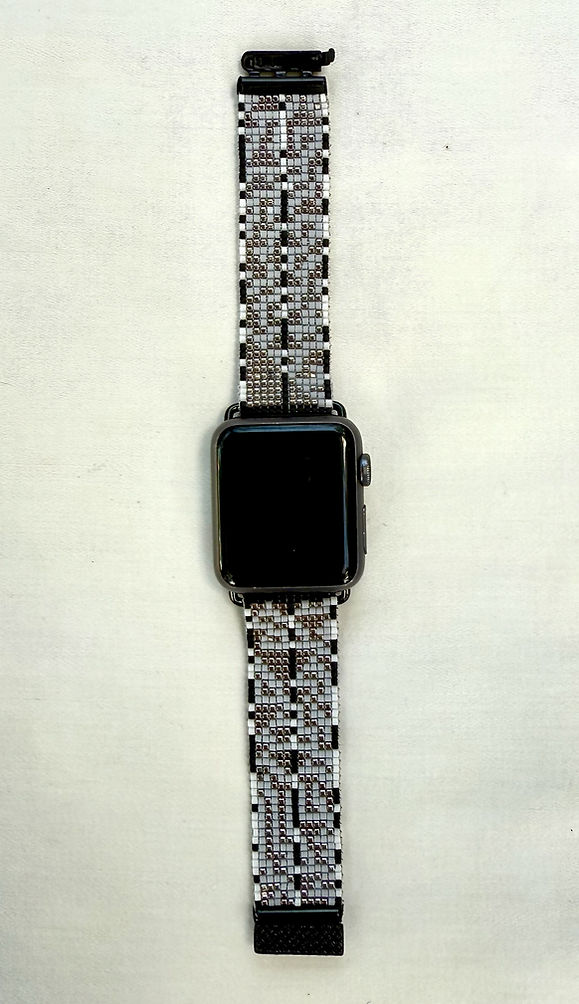
The third watchband is designed for the Apple Watch, the world's best-selling watch. Since their introduction in 2015, Apple Watches have included cryptographic features and dedicated hardware security. The band design draws on Stephen Wolfram's 1985 proposal to use cellular automata for cryptography.
Each side of the band uses a Rule 30 cellular automaton to encode part of the message "apple watch," with "apple" encoded on one side and "watch" on the other. For each side of the band, when the watch face is positioned at the top (north orientation), the binary ASCII code for each letter appears in black and white along the leftmost column of the band. The next eleven columns show the evolution of the Rule 30 pattern in shades of gray and silver, with the center column reproduced in black and white to serve as the encrypting sequence. Colors in the final column are determined by a bitwise XOR operation between the first (message) and center (encrypting) columns. If the center column bead is black, the color in the first column is reversed. If it is white, the color is copied unchanged. The pattern establishes a visual connection between binary logic and physical form, aligning the band's structure with the computational processes embedded in the watch itself.